
1873-2012
In the fall of 1888, Father John F. Leary, Pastor of St. Andrew's in Abilene, visited the Herington area to learn if there were any Catholic families living there and if they might be in need of his ministry during the smallpox epidemic that was spreading through the locality. He found that there were only a few Catholics in the newly established town with some on farms not far from town. He arranged for Mass to be offered in their homes on the fourth Wednesday of every month and the genesis of a Catholic Parish was underway.
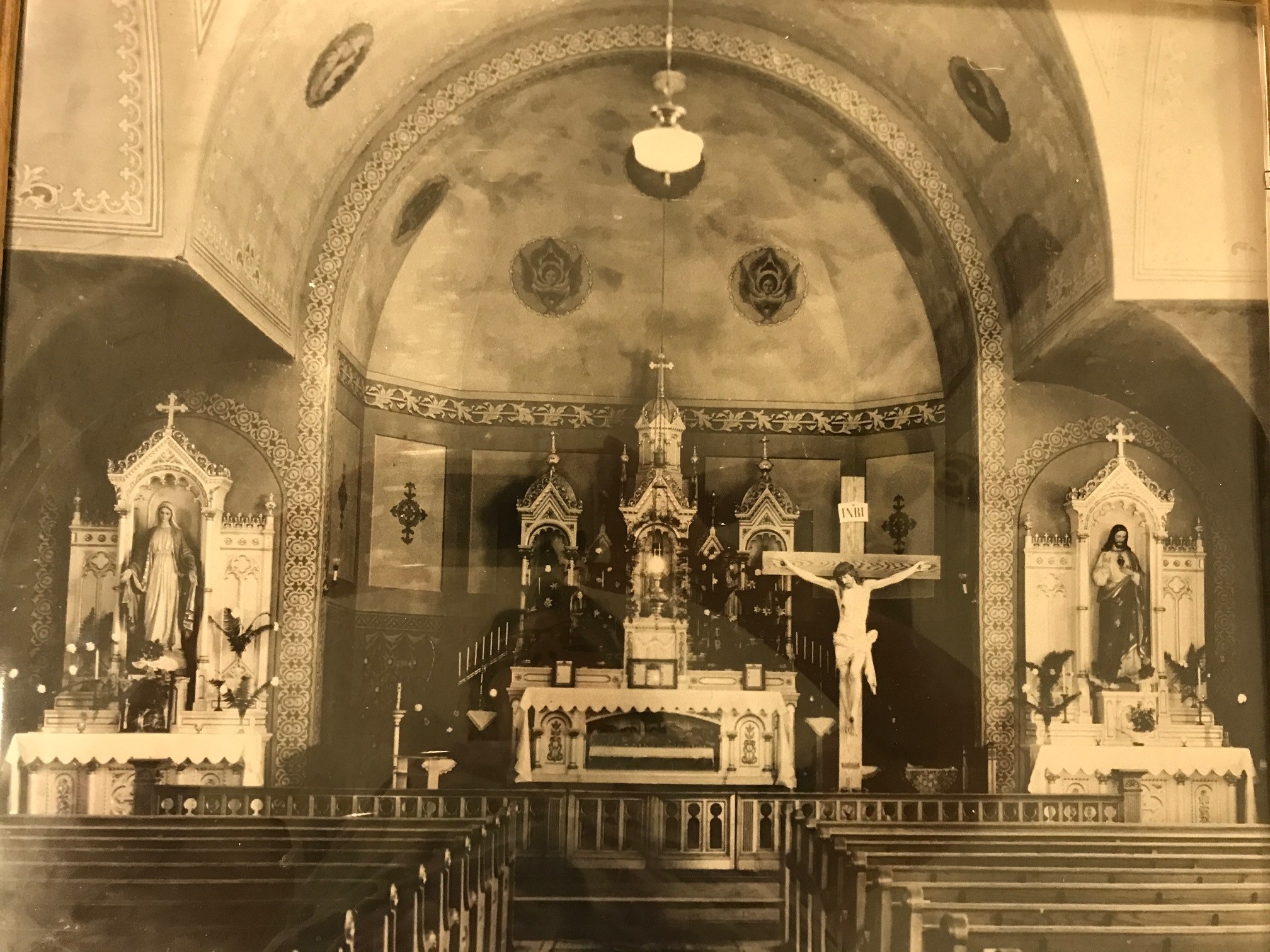
The first Catholic family to settle was that of Conrad Biehler six miles southwest of Herington in 1873, with the Damascus Biehler family following in 1878. The family of Thomas Parkin arrived in 1886 and settled northeast of Herington. Within town the family of M. J. Mullin came from the White City in 1888 to work in the hotel business. A locomotive engineer for the Rock Island Railroad, Christopher Dunn, came in 1887, the year the City of Herinton was founded. The next year, road master J. C. Smith arrived along with another engineer, James Murphy, from Denver.
By 1891, other families had arrived including those of William Heath, Peter Trapp, E. W. Burke, John Burke, Mrs. Kate Mertel and William Kurtenbach, and consideration was given to erecting a Catholic Church. Under Father Leary's guidance, a 24' x 40' church was built on the northwest corner of the intersection of B and Day streets. Mass celebration was increased to two Sundays each month in the new church. With the growth of both the town and the parish, a resident pastor was appointed in 1902, Father Arthur Van Speybroeck. The church building was moved to 408 South Broadway and renovated for the growing congregation. He lived with the Mullin familiy until a new rectory could be built. In 1903, Father Raymond Drees became pastor followed by Father Joseph B. Glynn who arrived on All Souls Day, 1904. It was under his pastorate that the current church was built on the 700 block of North Broadway. Bishop Cunningham laid the cornerstone on September 1, 1908. The completed church was dedicated on May 4, 1909; it cost $20,000. During the next year, the rectory was built at a cost of $5,000.
Besides raising funds to pay off the debt incurred by the construction of these two buildings, there was also a concerted effort to raise the money needed to build a parochial school. Fr. Glynn labored to this end until his transfer to Beloit in 1924. Father James McErlean continued the work, but poor health forced his retirement within a year and he was replaced by Father John Sheehan in August of 1925. On February 4, 1926, Father John Fitzgerald arrived to direct the completion of the school. By the fall of 1926, the new school which cost $60,000 was ready for the first students. It included four large classrooms, a music room and a gymnasium, which also served for parish functions, and some auxiliary rooms. The upper floor was used as a residence for the teaching nuns who staffed the school.
In 1968, Father Thomas Lonergan sent a letter to the 31 "school parents" of the 54 students concerting the financial responsibility of operating a parochial school. The projected cost for the coming school year was $13,000 with about 48% of the cost borne by the school families. In the spring of 1969, the school was closed, but the building was used by the parish for religious education and various parish functions until 1974 when the decision was finally made to raze the building. In a letter dated August 26 of that year, Bishop Vogel gave permission to raze the school and to proceed with plans for a new parish hall under the pastor of Father Larry Pierce. Measuring 50' by 72' overall, the new hall, costing $83,000, was completed in the spring of 1978.
In 1983, Father Richard Lutgen was appointed to St. John's with the additional care of the mission of St. Patrick's in Gypsum. On the weekend of August 12, 1984, Father Lutgen relinquished the Gypsum mission an assumed responsibility of St. Phillip's in Hope and St. Columba's in Elmo as missions of Herington. Fr. Donald Pfannenstiel arrived on July 16, 1986. Parish families numbered 120 with 285 parish members. In 1991 our parish family was extended to include those living in northern Marion County due to the closing of the churches in Pilsen and Tampa. Fr. Pfannenstiel led an extensive repair and renovation of the church interior in 1991.
On July 1, 1998, Fr. Randall Weber arrived to serve the parish for one year. Then Fr. Mark Wesely was appointed effective July 1, 1999 with St. Phillip, Hope and St. Columba, Elmo continuing as mission parishes. A new organ was donated by Leo and Lillian Biehler in 2003. Families have made significant contributions over the next years to restore and maintain the physical structure of our church building including a new roof, re-leading and restoration of all the stained glass windows, adding seat cushions and new carpet. In 2009 the church quietly celebrated its 100th anniversary and we pray that God will bless us as we embark on our second century.